
With the increasing number of industrial robots, will ordinary bearings be "phased out"?
When we step into a modern factory, the scene is completely different from what it was ten years ago. Robotic arms swing at high speed, AGVs shuttle back and forth, and automated inspection lines run non-stop.
According to data released by the International Federation of Robotics, the global installation of industrial robots has maintained high growth for many consecutive years, with the Asian market share continuing to expand, and China becoming one of the world's largest application markets.
The question arises—
As industrial robots become increasingly numerous, will those "ordinary bearings" be completely eliminated?
Today, we'll discuss this question scientifically and somewhat playfully from a technical perspective, considering market trends and application scenarios.
I. Where exactly does the "difficulty" of robotics lie?
Many people think that robots are simply "motors + reducers + control systems."
But what truly enables a robot to operate precisely is its joint system. And one of the core components of the joint system is the bearing.
1)A six-axis industrial robot typically has six rotary joints. Each joint:
2)must withstand combined loads (radial + axial + overturning moment)
3)must achieve high-precision positioning (repeatability error may be less than ±0.02mm)
must operate stably for extended periods (24/7, three shifts)
What does this mean for bearings?
In short: Robot bearings face the dual challenges of "extreme working conditions + extremely high precision."
II. Are ordinary bearings really "inadequate"?
Let's state the conclusion first:
They won't be eliminated, but they will definitely be repurposed.
Traditional deep groove ball bearings are still widely used in many pieces of equipment, such as:
1)Conveyor line motors
2)Fan systems
3)Packaging equipment
4)Low-to-medium precision mechanical structures
However, in the core joint positions of robots, ordinary bearings are indeed "inadequate."
Why?
1️⃣Different load types
Ordinary bearings typically bear loads primarily in one direction (radial).
Robot joints must withstand:
1)Radial load
2)Axial load
3)Moment load
In these cases, cross roller bearings or four-point contact ball bearings are more suitable.
III. How "extreme" are robot-specific bearings?
Let's break down some key characteristics.
1. High Rigidity
During welding, grinding, and handling processes, insufficient joint rigidity can cause "vibration" in robots.
High-rigidity bearings are characterized by:
1)Rollers arranged at 90° intervals
2)A single bearing can withstand multi-directional loads
3)Reduced clearance
Many high-end robot companies use high-precision bearing products, such as:
Harmonic Drive Systems
THK
These companies' products occupy a core position in joint deceleration structures.
2. Extremely Low Friction + High-Precision Preload
Robot Requirements:
1)Rapid Start-up
2)Rapid Stop-up
3)Precise Positioning
This necessitates:
1)Precise preload control
2)Extremely low surface roughness
3)Minimally small roundness error
Ordinary bearings may be P0 or P6,
while robot bearings often reach P5, P4, or even higher grades.
3. More Stringent Lifespan Requirements
Traditional equipment downtime for maintenance has relatively little impact.
However, in automated production lines:
If one robot stops, the entire line may come to a standstill.
Therefore, bearings must:
1)High fatigue life
2)Optimized lubrication design
3)Prevent fretting wear
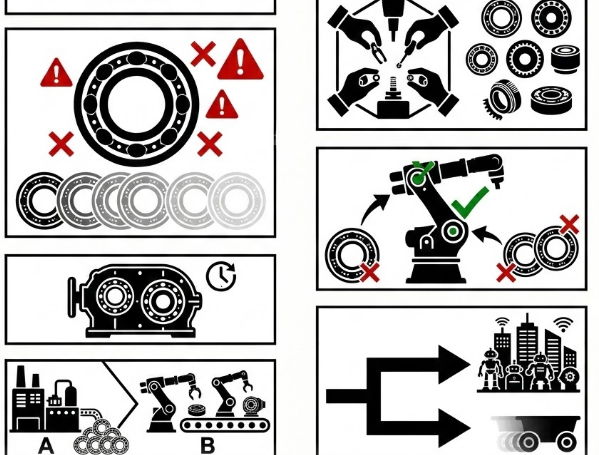
IV. Current Trends: Domestic Substitution is Accelerating
In the past, high-end robot bearings mainly relied on:
1)SKF
2)NSK
3)FAG
But with the upgrading of high-end manufacturing in China, domestic companies are making continuous breakthroughs in the fields of crossed roller bearings and precision rotary bearings.
Especially in:
1)3C assembly robots
2)Lithium battery equipment
3)Photovoltaic equipment
Domestic brands are gradually entering the supply chain.
What does this mean?
"Ordinary bearings" haven't disappeared, but "low-end bearings" will be phased out.
The future elimination won't be based on type, but on products with insufficient performance.
V. What changes will the explosive growth of industrial robots bring?
We analyze this from three perspectives:
1️⃣ Upgrading of Bearing Demand Structure
In the past, large-volume demand was for general-purpose models.
Future Trends:
1)Small-batch, high-precision customization
2)Modular bearing components
3)Integrated structural design
Bearing companies will shift from "selling products" to "selling solutions."
2️⃣ Material Upgrading
Problems caused by high-speed, high-frequency startup:
1)Heat generation
2)Electro-corrosion
3)Micro-vibration wear
Therefore, the following technologies emerge:
1)Ceramic hybrid bearings
2)Special coated bearings
3)High-purity bearing steel
3️⃣ Intelligent Bearings
Future possibilities include:
1)Built-in temperature sensors
2)Vibration monitoring modules
3)Real-time life prediction
This aligns perfectly with the Industry 4.0 trend.
VI. An Interesting Question: Will Robots "Destroy" the Bearing Industry?
Actually, quite the opposite.
Robots will cause the bearing industry to:
1)Raise technological barriers
2)Increase product added value
3)Increase industry concentration
Simply put:
Low-end products will be eliminated, while high-end products will become more profitable.
This follows the same logic as manufacturing upgrading.
VII. Where Will Ordinary Bearings Go in the Future?
Ordinary bearings will not disappear; they will shift to:
1)Logistics automation equipment
2)Agricultural machinery
3)Small and medium-sized equipment
4)Basic industrial sectors
While core joints in robots will utilize:
1)Crossed roller bearings
2)Precision swivel bearings
3)High-speed ceramic bearings
This will create a clear stratification.
VIII. Conclusion: What will be eliminated is not "ordinary bearings," but "bearings that cannot keep up with the times."
The increase in the number of industrial robots represents the manufacturing industry's higher requirements for:
1)Precision
2)Stability
3)Intelligence.
The bearing industry must also upgrade:
1)Higher precision
2)More complex structures
3)More systematic solutions
Therefore, the answer is clear:
1)✔ Ordinary bearings will not disappear
2)✔ However, products with insufficient performance and outdated technology will gradually be phased out of the market
3)✔ High-end precision bearings will usher in greater growth potential
 Warehouse Robots Never Sleep—Can Their Bearings Keep Up?
 How Bearing Downtime Can Cost Offshore Platforms Millions
 Hybrid Bearings vs Steel Bearings: Which One Wins in 2026?
 Why Are More Factories Switching to Sealed Bearings Instead of Open Bearings in 2026?