
About Us
Abnormal temperature rise and vibration noise: Interpreting early warning signals of bearing housing failure!
Views : 826
Update time : 2025-12-04 18:39:01
In the daily operation of industrial equipment, bearing housings are like the "joints" of machinery, and their health directly affects the efficiency and lifespan of the entire machine. However, many malfunctions do not occur suddenly, but rather provide early warnings through signals such as temperature, vibration, and sound. Understanding these "mechanical languages" allows for timely intervention at the stage of minor abnormalities, avoiding costly downtime and safety accidents.
I. Abnormal Temperature: The Most Intuitive Precursor to Failure.
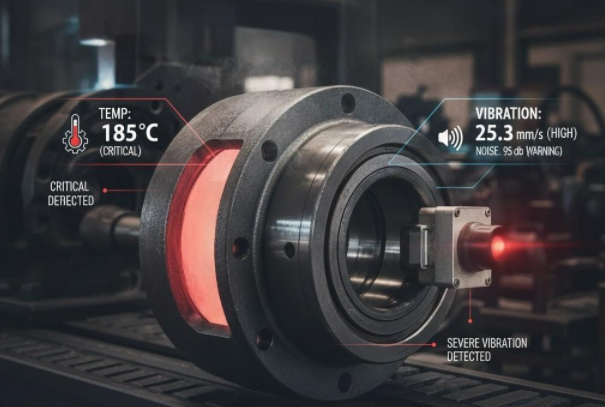
The temperature change of the bearing housing is the most direct indicator of its operating condition. Under normal circumstances, the operating temperature of the bearing housing should be 20-30°C higher than the ambient temperature. When the temperature rises abnormally, it often indicates the following problems:
Lubrication failure is the most common cause of temperature rise. Insufficient, deteriorated, or improperly selected lubricant will cause direct contact between metal surfaces, drastically increasing the coefficient of friction. For example, in a chemical plant, the temperature of a pump bearing housing soared from 65°C to 120°C in just two hours due to hardened grease. Timely shutdown and grease replacement prevented bearing seizure.
Excessive tightness can also lead to abnormal overheating. Improper fit between the bearing and the shaft/housing bore during installation can cause excessive preload. Maintenance records from a wind farm show that interference fits caused by installation errors resulted in the gearbox bearing housing operating temperature consistently exceeding the normal value by 15°C, leading to fretting wear after prolonged operation.
Monitoring Recommendation: Regularly monitor the surface temperature of the bearing housing using an infrared thermometer, paying particular attention to the uniformity of temperature distribution. Temperature differences exceeding 5°C between multiple bearing housings in the same equipment, or significant temperature differences between different measuring points on the same bearing housing, require attention.
II. Vibration Signals: Sensitive Indicators for Capturing Microscopic Damage.
Vibration analysis is the most precise technical means of diagnosing the condition of bearing housings. Different vibration frequencies and characteristics correspond to specific fault types:
Fatigue spalling in the early stages produces impact vibrations. When micro-spalling occurs in the bearing raceway or rolling elements, transient impacts are generated with each rotation to the defect. The increased energy of the high-frequency components (2000-6000Hz) of this impact vibration is often a clear signal of the early stages of fatigue.
Misalignment faults typically exhibit second harmonic characteristics. Even a 0.1mm misalignment between the motor and pump shafts can cause significant radial vibration in the bearing housing, with the vibration frequency strictly equal to twice the rotational speed. In a cement plant, misalignment of the fan bearing housing due to foundation settlement caused the vibration value to rise from 2.1mm/s to 7.5mm/s; after correction, the vibration returned to normal.
Loosening issues generate abundant harmonics. When the bearing housing fixing bolts loosen, multiple harmonic components (1x, 2x, 3x...) of the rotational speed frequency will appear in the vibration spectrum, accompanied by an increase in axial vibration. This "harmonic family" is a typical characteristic of loosening faults.
Monitoring Recommendations: For critical equipment, it is recommended to install an online vibration monitoring system; for general equipment, conduct handheld vibration testing at least once a month, recording the trends in parameters such as the effective velocity (RMS) and peak value.
III. Abnormal Sounds: The Most Easily Detectable Sensory Signal.
Trained operators can detect early faults through changes in sound: a normal bearing housing runs smoothly, emitting a uniform "humming" sound; poor lubrication produces a distinct rhythmic "clicking" sound, the frequency of which is related to the rotational speed; a damaged cage produces an irregular "clattering" sound, similar to rolling sand; after severe wear, a continuous "rumbling" sound indicates excessive clearance.
For example, on a car assembly line, an operator reported a slight "hissing" sound from a conveyor belt bearing housing. Disassembly revealed slight wear on the sealing lip, which was promptly replaced, preventing grease leakage and bearing seizure.
IV. Multi-Signal Comprehensive Analysis: Improving Diagnostic Accuracy.
Single signal analysis can lead to misdiagnosis, while multi-parameter correlation analysis significantly improves diagnostic reliability:
Temperature and Vibration Correlation: A slow rise in temperature accompanied by an increase in high-frequency vibration energy likely indicates poor lubrication; if the temperature is normal but vibration increases, it is more likely due to loose components.
Sound and Vibration Spectrum Comparison: Abnormal sounds correspond to specific frequency components in the vibration spectrum; combining these two can accurately pinpoint the fault location.
Establish an equipment health baseline: Record normal temperature and vibration values for the first week after new equipment is put into operation as a baseline. Comparing subsequent monitoring data to this baseline makes it easier to detect subtle changes.
V. Develop a scientific early warning and response process.
Yellow Alert (Attention Level): Temperature or vibration values exceed the baseline by 20%, but do not exceed the alarm value. Response: Increase monitoring frequency, check lubrication status, and prepare a maintenance plan.
Orange Alert (Warning Level): Parameters exceed the baseline by 30-50%, or characteristic frequencies appear. Response: Schedule a shutdown inspection within one week and prepare spare parts.
Red Alert (Emergency Level): Parameters exceed the baseline by more than 50%, or vibration values rise sharply. Response: Immediately shut down the equipment for maintenance to prevent damage.
A typical case was recorded in the bearing housing monitoring system of a mine crusher: In the first week, the vibration value slowly increased from 2.1 mm/s to 2.8 mm/s (yellow warning). The maintenance team arranged a weekend inspection but found no obvious abnormalities. In the third week, the vibration increased to 4.2 mm/s, and the spectrum showed the characteristic frequency of inner ring failure (orange warning). Repair was planned three days later. On the fourth day, the vibration suddenly increased to 8.5 mm/s (red warning). The machine was immediately stopped and disassembled, revealing premature spalling of the inner ring. Replacing the bearing avoided significant losses due to journal wear.
Practice has proven that establishing a systematic condition monitoring system can shift the maintenance strategy from "repair after failure" to "predictive maintenance," reducing equipment failure rates by more than 60% and maintenance costs by 30-40%. Mastering the "language" of bearing housings means mastering the initiative in equipment management.
相关新闻
 Warehouse Robots Never Sleep—Can Their Bearings Keep Up?
Jul 20,2026
Warehouse Robots Never Sleep—Can Their Bearings Keep Up?
 How Bearing Downtime Can Cost Offshore Platforms Millions
Jul 16,2026
How Bearing Downtime Can Cost Offshore Platforms Millions
 Hybrid Bearings vs Steel Bearings: Which One Wins in 2026?
Jul 14,2026
Hybrid Bearings vs Steel Bearings: Which One Wins in 2026?
 Why Are More Factories Switching to Sealed Bearings Instead of Open Bearings in 2026?
Jul 07,2026
Why Are More Factories Switching to Sealed Bearings Instead of Open Bearings in 2026?